
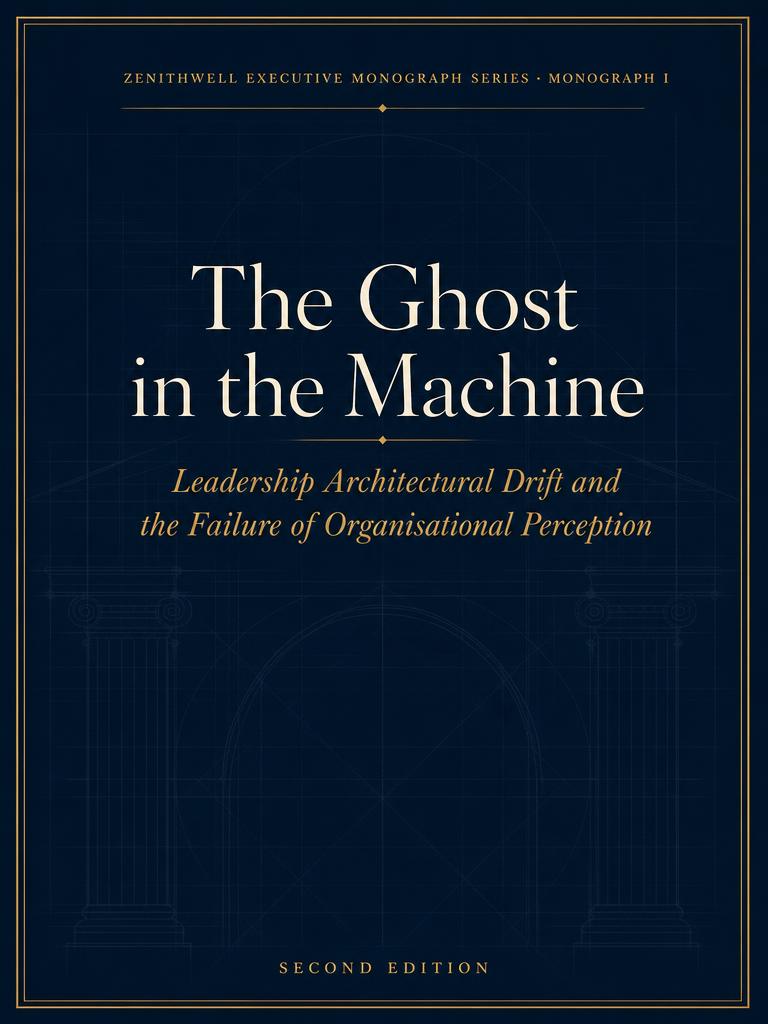
The Ghost in the Machine
Leadership Architectural Drift and the Failure of Organisational Perception
- Author
- Merlin Lockey, GSM
- Publisher
- ZenithWell
- Publication date
- July 2026
- Edition
- Second Edition
Available in full without registration.
Large organisations rarely fail because they cannot generate information. They fail because they gradually lose the capacity to distinguish organisational reality from organisational reporting. This distinction is the founding subject of the monograph, and of the discipline it introduces: Leadership Architecture.
Leadership Architectural Drift is defined as the progressive divergence between strategic intent, governance structure, reporting signal, and operational reality — occurring not through individual failure but through the ordinary structural behaviour of hierarchy under pressure. It is the first clinically defined condition within the discipline.
The paper's second finding concerns the instrument organisations trust to detect drift: reporting itself becomes least reliable precisely when it is most needed. Correction requires an independent perceptual instrument — observation conducted outside the architecture being examined. This is the founding proposition of ZenithWell.
- 01Read →
- 02Read →
- 03Chapter TwoThe Consultancy ParadoxRead →
- 04Chapter ThreeThe High-Stakes CrucibleRead →
- 05Chapter FourThe Financial LedgerRead →
- 06Chapter FiveThe Independent DiagnosticRead →
- 07Read →
Lockey, M. (2026). The Ghost in the Machine: Leadership Architectural Drift and the Failure of Organisational Perception. ZenithWell Executive Monograph Series, Monograph I (Second Edition). ZenithWell.
The monograph may be cited, referenced and shared without permission provided the recommended citation is used. For commercial republication or translation, please contact ZenithWell.
- Monograph IIDecision Integrity Under StrainIn preparation
- Monograph IIIThe Architecture of Executive CoherenceIn preparation
- Monograph IVCross-Border Execution: Why Global Transformations Lose Their WayIn preparation